

What Really Happened on the Mountain? Sunday Breakfast with the Word. Second Week of Lent Year A

Sunday Breakfast with the Word. Second Week of Lent Year A
Click here for the Shorter Version
Genesis 12: 1-4, 2 Timothy 1:8-10, Matthew: 17: 1-9
What Really Happened on the Mountain?
As the Lenten journey gradually proceeds, the Gospel today presents to us with a story of the transfiguration.
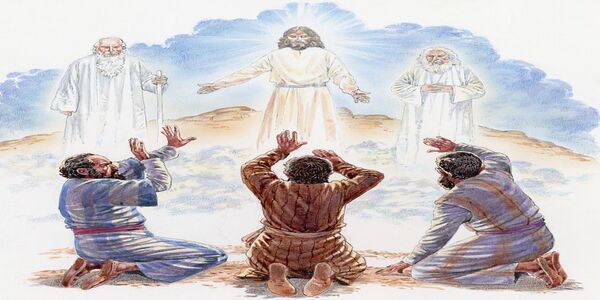
In today’s gospel, Jesus takes Peter, James, and John up to a high mountain. There, before their very eyes, his appearance changes. His face shines like the sun. His garments become dazzling white, then Moses and Elijah appear, speaking with him. A cloud descends. A voice speaks from heaven. The disciples fall in fear. Jesus touches them. And then, in silence, they descend the mountain.
These stories should not be taken in a literal sense. What the gospel presents to us is not an ordinary event but an event that its interpretation has a huge impact and relevance to our spiritual lives. Let us take it gradually, step by step.
The Meaning of “Transfiguration”
The word “Transfiguration” comes from the Latin transfiguratio, meaning “to change in form.”
The Greek word used in the Gospel is metamorphoō (Matthew 17:2), from which we get the English word “metamorphosis.” This describes a transformation that reveals what was hidden.
During the transfiguration, Jesus did not become something He was not before. Rather, what was always true about him was unveiled.
During the transfiguration, His divine glory, ordinarily concealed beneath human flesh, then began to shine through.
Therefore, the transfiguration is not about Jesus acquiring glory. It is about Jesus revealing His glory. And that is important. Because this same Greek word appears again in the bible.
In Romans 12:2, Paul says, “Be transformed (metamorphoō) by the renewing of your mind.”
In 2 Corinthians 3:18, he says we are being “transformed into the same image from glory to glory.” Therefore, the transfiguration is not just about Jesus but us. The mountain is not only about Christ. It is also about us.
Therefore, the transfiguration is telling us what we must do in this Lenten season. It is a season we must transform. This is a time we have to make sure we undergo renewal.
It is not season, to keep piling our sins, wickedness, weakness and lack of prayer life. It is not season, to keep planning on the next sin to commit, but a sin we have to ascend the mountain of prayer and encounter with God.
The Ascent of the Mountain
The Gospel tells us that Jesus led the three disciples “up a high mountain by themselves” (Matthew 17:1). The first thing we have to understand is the significance the word “mountain in the bible.
Mountains in the bible are seen as places of encounter. Moses met God on Mount Sinai (Exodus 19). Elijah heard the still small voice on Mount Horeb (1 Kings 19).
The mountain is that sacred place you set up to have deep encounter with God daily. It is that altar where your pour all your tears before God.
Also, the Sermon on the Mount was proclaimed on a hillside (Matthew 5–7). On this mountain, Jesus proclaimed blessings on many.
It means that on every mountain, there is a proclamation of blessing, you can never ascend a mountain and remain the same.
The lenten season or lenten program is another moment of encounter. Therefore, mountains symbolize elevation not just physically, but spiritually.
Thirdly, to ascend is to detach. To climb is to leave behind the noise of the valley. Jesus chooses only three disciples.
This is not because the others were unworthy, but because intimacy requires deep focus. We have to concentrate. We do not need the crowd.
We need moments of personal encounters. Remember that there at the mountain, they received revelation. So, revelation, requires ascent.
We cannot expect profound encounters with God while remaining spiritually un-alert.
When you choose to pray, you choose to ascend.
Prayer is a climb. Silence is a climb. Sacrifice is a climb. Before the glory, we must choose to ascend.
You are not doing this Lenten program because yo want to be rich, because you want to be the most powerful man or woman or earth, or to acquire the highest material blessings from God.
You are part of the Lenten season, because you are so hungry to have a spiritual transformation.
For the transformation to occur, Jesus chose the mountain as the place of encounter. It means that every prayer encounter you choose to have this season, must surely transform your life.
The Radiant Christ: Glory Revealed
Matthew tells us, “He was transfigured before them. His face shone like the sun, and his clothes became white as light” (Matthew 17:2).
This language is a kind of reminding us what happened when Moses was descending from the mountain Sinai, his face became so radiant after speaking with God (Exodus 34:29–35).
The cool difference is that Moses reflected glory of God while Jesus His own radiates glory. Did you understand?
We have to understand that here, Moses reflected the glory of God after his encounter, but the brightness shone by Jesus is not borrowed nor reflected. It is comes from within.
This is telling us what happens when you visit the Blessed Sacrament or when you go to God in prayer. That prayer encounter makes you a light. You cannot but radiate the glory of God.
In the presence of the Blessed sacrament, You encounter grace upon grace. You encounter healing, joy, mercy and total transformation.
This is why John later writes, “We have seen his glory, the glory as of the only Son from the Father” (John 1:14). On the mountain, that glory breaks through the veil of flesh.
Why does Jesus reveal this to them?
Because the cross is coming. Soon they will see him disfigured, beaten, mocked, crucified. The transfiguration prepares them for the Passion. It assures them that suffering does not cancel glory.
Beloved, sometimes God gives us glimpses of light before we enter dark valleys. This is the reason I tell people that whoever encounters God truly will hardly lose faith in Him in the moments of trials. The memory of grace sustains us when faith is tested.
Moses and Elijah: The Law and the Prophets Fulfilled.
Suddenly, during the transfiguration, Moses and Elijah appear, speaking with Jesus. Moses represents the Law while Elijah represents the Prophets.
Together they embody the entire Old Testament revelation. Their spiritual presence is not accidental. It is theological.
The Law and the Prophets point toward Christ. Jesus himself said, “Do not think that I have come to abolish the Law or the Prophets; I have come not to abolish but to fulfill” (Matthew 5:17).
Therefore, to succeed here on earth, to truly do the will of God, and to achieve salvation , all we need is Jesus.
The conversation between Jesus, Moses, and Elijah signifies continuity and fulfillment. Luke tells us they were speaking of his “departure” (Luke 9:31), literally his “exodus.”
This simply indicates that just as Moses led the people of Israel out of slavery, Jesus will lead humanity out of sin.
Remember that after the conversation, they disappear. This is pointing to us that the Law and the Prophets step aside. Jesus remains alone.
The message is unmistakable. Jesus Christ is the definitive revelation of God.
Peter’s Speech: The Desire to Stay
Peter, overwhelmed, says, “Lord, it is good that we are here. If you wish, I will make three tents” (Matthew 17:4).
Peter wants to preserve the moment. He wants to build structures around glory.
We understand him. When we experience spiritual consolation, we want it to last forever. We want to freeze mountaintop moments.
sponsored
But faith is not about building monuments to past experiences. It is about following Christ forward.
Peter speaks before fully understanding. Often, we do the same. In moments of divine mystery, silence is better than construction.
The Cloud and the Voice: Divine Confirmation
While Peter is still speaking, a bright cloud overshadows them. The cloud here recalls the Shekinah glory, which is the visible manifestation of God’s presence in the Old Testament (Exodus 40:34–35).
It signifies both revelation and mystery. Then, from the cloud comes the voice: “This is my beloved Son, with whom I am well pleased; listen to Him.”
These words was said during Jesus’ baptism (Matthew 3:17), but now there is an added command: Listen to him. This is the Father’s interpretation of the event.
He is saying, “if you want to gain life, wisdom, eternal salvation etc listen to Jesus Christ. Or He is reminding us that we are just visitors to the world, if you want to succeed in this earthly journey or understand its mysteries and divine principles, we have to listen to Jesus.
God the father has a message for us, but the only way to grab that message is to listen to Jesus.
God is saying: Listen to Him above Moses. Listen to Him above Elijah. Listen to Him above your fears. Listen to Him above your assumptions.
Listen to Him above that social media influencer, you always choose to read everyday. Listen to him to keep your family, life,marriage etc properly guided.
Hebrews 1:1–2 tells us: “In many and various ways God spoke of old… but in these last days he has spoken to us by his Son.” Jesus is not one voice among many. He is the final Word.
So, during your own moments on the mountain, do not forget to meditate, stay silent for a while after your prayers to be properly guided. On the mountain, we receive a lot inspiration to succeed.
Fear and the Gentle Touch.
During the transfiguration, The disciples fall on their faces in terror. Remember what Isiaiah did when He encountered the glory of God. When Isaiah saw the glory of God, he cried, “Woe is me!” (Isaiah 6:5).
When John saw the risen Christ, he fell as though dead (Revelation 1:17). This means that Divine holiness exposes human frailty. Hence, Jesus comes and touches them and says “Rise, and have no fear.”
So, the One who radiates divine majesty also offers human tenderness. The same hand that commands storms now lifts His trembling friends.This is showing mercy and glory at the same time.
So, Christianity is not merely about encountering His transcendence; it is about being touched by God’s mercy.
On this special Lenten mountain season, the mercy of God is super abundant. Reading these, you will understand what truly happens on the mountain.
Today, when they lift their eyes, they see “Jesus only.” That is enough. In the midst of our fears, we have to be confident that we are not alone. His presence is all we need to be victorious at the end.
The Descent: Silence Until Resurrection
As they descend, Jesus commands them not to speak of the vision until after the resurrection. So, one may ask, Why silence?
Because without the resurrection, the transfiguration could be misunderstood. This is teaching us not to be fast to expose everything happening in our lives.
When your life is being transformed, keep your mouth shut.
Also, Jesus wants them to link the transfiguration to his passion and then to his resurrection. It means that the glory without the cross is incomplete.The journey is not yet complete without the passion.
Thomas Keating insightfully says that no one in the valley would understand unless they had climbed the mountain. When you climb the mountain, your life will change.
Spiritual truths are grasped through participation, not explanation.
From Mountain to Table
Soon we will gather at the Table. The mountain prepares us for the Eucharist. Just as the disciples on the road to Emmaus recognized Jesus in the breaking of the bread (Luke 24:30–31).
We encounter the transfigured Lord in sacramental presence.
The same Christ who shone on the mountain is present in humble bread and wine. He is there in the Blessed Sacrament. His Glory often hides in simplicity.
Conclusion
1. Jesus often withdrew to pray (Luke 5:16). If the Son of God needed solitude, how much more do we? We cannot live perpetually in the noise of the valley. Let us seek the mountain of prayer.
During this Lenten season, try and carve out time for moments of silent prayer. Climb daily, even if only for fifteen minutes. That few minutes or one hour is life changing.
A lot happens spiritually when we pray. Since prayer is a spiritual encounter, you may not actually see physically what happens when a soul goes deeply in a prayer encounter.
This is where graces are poured like water. This is where spiritual strength is given. This is where we draw light to became light for others.
If you want to be a light, if you want to change, to be wise, to receive ideas and inspiration from God, you need solemn moments of spiritual encounter. You need a time of prayer.
2. The Transfiguration precedes the cross. When trials come, remember the glimpses and abundance of His grace. His grace is ever abundant and sufficient.
Remember His grace in the times of suffering.
Also do not forget that the suffering can still lead to your glory Paul says, “The sufferings of this present time are not worth comparing with the glory that is to be revealed.” Hold onto the light when darkness descends.
3. Also, we have to listen to Jesus above all voices. In our culture that is filled with competing narratives, we have to return to the Gospel.
Let Jesus Christ shape your conscience, your decisions, and your identity.
Any time you face a situation, you do not know what to do, Ask yourself daily: What would Jesus say? Then do whatever He says.
When you face problems or moments of indecision, ask “What did Jesus advise us that we do here, follow what He says.
His words will save you more than that Social Media influencer that is misleading you.
4. The same word used for Jesus’ Transfiguration is used for our transformation. Like Saint Paul says, Let us renew our minds through the bible.
Let us renew our hearts through sincere repentance. We have to renew our life through obedience to the word of God. Gradually, your life will begin to change.
Transformation is gradual but real. This is the time to allow the Lenten encounter with Jesus Christ to transform You. Are you ready? are you prepared? or are we still busy?
5. The disciples were afraid, but Jesus touched them. When God disrupts your comfort, do not run. His glory does not destroy, it purifies.
He said “Fear not, for I am with you.”
In Moments of fear, that touching Hand is a reminder that you are not alone.
So, the transfiguration is an invitation and revelation of the saving hands of God in the times of fear.
6. Let us now climb the mountain. Behold Him. Listen. Be touched. Descend. Be transformed. and transform others.
May we allow ourselves, to see beyond what is merely physical. May we join Peter, James, and John in beholding Christ’s splendour.
We have to develop the love of visiting the Blessed Sacrament. And as Paul promises, may we be transformed by the renewing of our minds, so that we may discern the will of God, which is what is good, pleasing, and perfect.
When we leave this place, may others see in us a reflection of that mountain light. And when fear comes, may we hear again the gentle voice: “Rise. Do not be afraid.”
Always do not forget that a saving hand is with you always. Profess it, believe it and live with it.
Beloved May God help us to continually. transform our mind and hearts daily through his words, Amen.
sponsored