

A King Who Saves, Not a King Who Dominates. Solemnity of the Christ the King

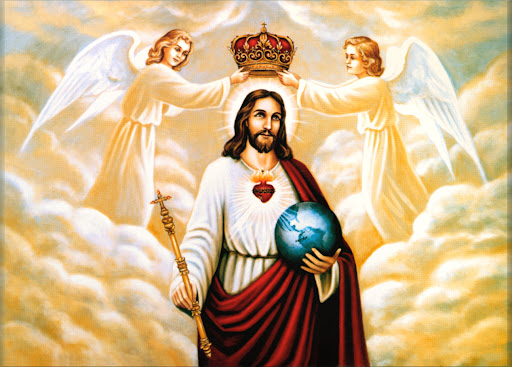
Sunday Breakfast with the Word: Solemnity of the Christ the King
Theme: “A King Who Saves, Not a King Who Dominates”
Introduction.
We all know that normally, kings are usually surrounded by power, soldiers, crowns, and thrones. A king commands respect and demands obedience.
In the time of Jesus, the power of kingship revolved around who was more powerful, dominating and influential.
The King we are celebrating today is not a king who wields absolute power, full of threat and intimidation. We are not celebrating a king whose intention is to rule with a mighty hand, using threats and ammunition to prove his power or to demonstrate to people that he is in charge, thereby showcasing his authority.
The King we celebrate today is a different one. We celebrate a king who is not like the rulers of this world.
The king we celebrate today is the king who loves to sacrifice for the people He loves. Our King hangs upon a cross. Our King wears a crown of thorns. Our King rules not by force, but by love.
Could you imagine that the greatest throne our King ever sat upon was the Cross? At that time, many saw the Cross as the worst form of suffering and death. Yet through the Cross, our King conquered not nations, but sin and death.
So, the Feast of Christ the King invites us to ask: What kind of King is Jesus, and what kind of kingdom does He offer us?
The Background.
After World War 1, many people turned away from God. Many Christians who felt that God had abandoned them during the time of suffering lost faith in God.
Many nations reject God, while many leaders have begun to see themselves as supreme or more omnipotent. This led to loss of faith, radical rejection of God’s authority and presence.
So, in the year 1925, Pope Pius XI looked at the world and saw that nations were rejecting God, the rising atheism, dictators wanting absolute power, Violence, wars, and the collapse of morality, Christians becoming lukewarm and ashamed of their faith, People were beginning to live as if God did not exist.
To respond to the crisis, Pope Pius XI established the Feast of Christ the King, declaring: “No earthly leader has the final authority, only Christ is King”.
So,the feast of Christ the King was to reaffirm that, despite how powerful the political leaders are, Jesus Christ only rules the universe, to remind Christians that our loyalty belongs first to Christ, not to governments, wealth, or power, and finally to strengthen the faithful in a world growing hostile to Christianity.
Today, this feast is still more relevant. Many people today are still living as if God does not matter. Today, the church is reminding us that Christ is King, now and forever.
1.David As A Foreshadowing of Christ the King.
a.The first reading of today describes a historic and sacred moment in the life of the people of Israel.
In the first reading, David is officially anointed and accepted as king by all the tribes of Israel.
All the tribes came to David in Hebron, that is, almost the entire nation, both north and south, united together. Remember that after the death of Saul, Israel was divided, but here they came together to unite under one king.
b.They reminded David that they are his flesh and blood. This actually means that they recognise David as one of their own.
Therefore, this expresses that David is not a foreigner,nor a stranger, but part of the family. So, the indication is that their King is not distant but part of them.
c.So by celebrating Christ the King, we are acknowledging that Jesus Christ is not distant but close, and we should not treat or see Him as someone who is very far from us, but one who listens and understands us.
The statement “We are your flesh and blood” indicates that the tribes of Israel acknowledge David as their rightful king. This prefigures Jesus the King, who shares our humanity.
d.Just like David shares the identity and struggles of His people, Jesus does the same to us. He shares in our suffering and challenges. When you say that Christ is the King, you are actually saying that you are making Jesus part of you. Remember that He became one with us by taking our human nature. He should be part of your daily activities. Involve him in everything that you do.
c. The people reminded David how he had led Israel in all their exploits. Even when Saul was king, David was the one who led the battles, protecting and defending Israel, while risking his life. So, they recognised his leadership, courage, sacrifice, and service.
David acted like a true king even before he sat on the throne. Just like Jesus, who loved, healed, and saved even before being proclaimed King on the cross.
d. In the first reading, the visitors said to David, “The Lord said to you, You are the man who shall be shepherd of my people Israel, you shall be the leader of Israel.”’
Here, they defined the true nature of Kingship or leadership per se. Here, kingship is described as shepherding. Leadership is not a type of dominating. Shepherding means wholeheartedly seeking the welfare of the flock. It involves total care.
e.A shepherd guides, protects, cares, and sacrifices for the flock. This shows that God chose David not to be a tyrant, but a servant king.
Kings usually dominate, but shepherds care. Jesus is the Shepherd-King who knows His sheep and lays down His life for them.
Again, this foreshadows Christ the King, the Good Shepherd. It also teaches us what to do if we sincerely and truly want to be good leaders to those under our care.
In all places, whether in families, churches, communities, and organisations, our call is not to intimidate but to care, lead with love, guide and sacrifice for those under our care.
f. They said to David, “It was you who led Israel in all their exploits. Here, we can see that David was recognised not for power, but for service.
Jesus, too, says: “The Son of Man came not to be served, but to serve.” The call to lead, to be the one, to be great, etc., must come from service. Service is the secret. Whoever wants to be the number one must be ready to serve.
g. In the first reading, the elders came and made a covenant with David. This is not just a political agreement. It is a sacred pact, done “in the presence of the Lord.”
We need to understand the steps undertaken in the covenant. In this covenant, David promises to lead with justice and faithfulness, and the people promise loyalty and obedience. God Himself is part of the agreement. It is both spiritual and national.
h. Finally, they anointed David the king of Israel. Anointing means: chosen by God, empowered by the Spirit and consecrated for leadership.
This is David’s formal coronation. He becomes the king God promised. This moment also prepares for the coming of Jesus, the Son of David, the eternal King.
This foreshadows Jesus’ kingship, though not anointed with oil, but anointed with the Holy Spirit and crowned with thorns.
In essence, a leader must be totally united and connected with God and be ready to be bruised for the sake of others.
2.Christ the King Over All Creation.
In the second reading, Paul gives us one of the most beautiful descriptions of Christ’s kingship. He says, “He has taken us out of the power of darkness.” Re-read that again. The kingdom cannot but take us out of darkness.
Therefore, the Kingdom of Christ is not a kingdom ruled by the kingdoms of darkness.
It is not a kingdom filled with bribery and corruption; it is not a kingdom where sin takes the order of the day. It is a kingdom of light, freedom and forgiveness. Where Jesus takes precedence, light takes precedence.
b. Paul also says that “He is the image of the invisible God.” If you want to know what God looks like? Look at Jesus. It means that He rules. He is the Almighty. Nobody is Almighty, Nobody is omnipotent, and nobody does it all except Jesus Christ.
c.Christ is King because He is the Creator. Paul says that “All things were created through Him and for Him.”That means: everything in our life only makes sense when it is connected to Him. “He holds all things in unity.” So when life feels scattered, broken, or chaotic, Christ holds the pieces together.
d. So today we are also celebrating our leader. Saint Paul says that “He is the head of the Church.” The Church does not rely on presidents; her ultimate leader is Christ Himself.
Whatever we do in the church, we do it for Jesus. When you fight against the church , just as Paul did initially, you are actually fighting against the body of Christ.
Remember the words of Jesus, “Saul, Saul, why are you persecuting me” (Acts 9:4-8) and whatsoever you do to the least of my brothers, that you do unto me. (Matthew 25:40)
e.Saint Paul says, “All things to be reconciled through Him and for Him,everything in heaven and everything on earth,when he made peace by his death on the cross. Therefore, His throne is the Cross. His power is love. His victory is reconciliation. And his modus operandi is sacrifice for the good of others.
So, a true leader conquers and succeeds with love and sacrifice.
sponsored
Jesus Reigns From the Cross.
This is the most shocking image of Christ the King. He is not seated on a golden throne, but hanging on a cross. Such imagery of a King is rare.
Let’s break it down verse by verse in an exegetical style.
a.The people stayed there before the cross watching Jesus. As for the leaders, they jeered at him. They said, ‘He saved others,’ ‘let him save himself if he is the Christ of God, the Chosen One.’
We can see that the crowd is indifferent. They could not do anything to save Him. They watch as the leaders are hostile to Jesus and mocking Him. They actually misunderstand kingship.
A true king does not save himself; He saves His people. A true leader is ready to undergo the highest form of sacrifice and persecution to save His people.
If you want to be a leader but are not ready to face the highest form of mockery, hatred and indifference from people, know that you are not yet.
2.The soldiers mocked him too, and when they approached to offer vinegar, they said, ‘If you are the king of the Jews, save yourself.’
So, even foreigners ridiculed Him. Christ the King experiences rejection from all sides. No earthly king could accept what Jesus accepted for the good of all mankind. He faces ridicule from every side.
3.Above him there was an inscription: ‘This is the King of the Jews.’
The above inscription was actually meant to mock Him. Imagine a whole King hanging on the cross. Hence, in trying to mock Jesus, the truth.
He is a king, but of the cross, not a king without a cross. It means Jesus is a king for all.
He is a king ready to die for the sake of others, a king willing to commit his life to see that others are saved. Other kings would have done the opposite.
4.One of the criminals hanging there abused him. ‘Are you not the Christ?’ he said. ‘Save yourself and us as well.
This criminal is not interested in understanding what is playing. He represents those who only want Jesus for miracles, benefits, or escape from suffering.
This first criminal does not understand who Jesus truly is. He mocks Jesus and treats Him like a magician or a miracle machine.
Check that question again; He is saying, “Are you not the Christ? Save yourself and us as well!” showing that He is not asking out of faith.
He is demanding out of desperation, frustration, and selfishness. So, He represents many people today who: only call on Jesus when they want a miracle, those who seek God not out of love, but out of convenience, they want Jesus to remove their pain, but don’t want a change of heart.
They are not interested in the salvation of their sins; their interest is only in material gain. These are those who come to God for benefits, and when the benefits do not come, they lose faith.
They are those who treat God like an emergency exit, not a King; they believe only if they get what they want.
You can see that the criminal wants escape, not salvation. He wants relief, not repentance. He wants miracles, not a Messiah.
This criminal is exhibiting a tragic attitude towards Jesus: a heart that demands power and miracles but refuses transformation. This is the reason many people today have lost faith in God.
5.But the other spoke up and rebuked him. ‘Have you no fear of God at all?’ he said. ‘You got the same sentence as he did, but in our case, we deserved it: we are paying for what we did. But this man has done nothing wrong.
The other thief actually acknowledges three things: God deserves more reverence, we are sinners, and Jesus is innocent.
This is true repentance. It involves acknowledging our unworthiness before God and relying on God’s mercy.
It involves relying not on our own self-righteousness but on the mercy and love of God.
6.Jesus,’ he said, ‘remember me when you come into your kingdom.’
This one is more interested in the salvation of his soul. He is interested in eternity. He is telling us where we all must focus first. In fact, this is one of the greatest prayers in Scripture.
It is short, humble, and sincere. A prayer that Jesus never ignores. When we humble ourselves before God, our prayers are always effective.
7.‘Indeed, I promise you,’ he replied, ‘today you will be with me in paradise.’
Here is the King’s royal decree: He does not condemn, rather He saves.
The first person to enter His kingdom is a repentant sinner. This is the King we celebrate.
CONCLUSION
1. Christ is a King who serves, not dominates. He does not move out with sirens issuing threats and intimidation. He rules by washing His feet, healing the wounded, embracing sinners, and carrying a cross.
The true secret of greatness is service, not intimidation. Therefore, we need to commit ourselves to the love and service of others if we truly want to be great.
2. Christ’s kingdom is built not on power, but on love. His Kingdom is not by violence, threats, fear, or political force but by mercy and sacrifice.
If Christ’s kingdom is built on love, mercy, and sacrifice, then we must build our daily lives the same way.
This means we have to choose mercy over revenge. When someone hurts you, the world says: Get revenge. But Christ the King says: Forgive. So, let go of grudges.
Stop rehearsing hurts in your mind. Pray for the person who offended you. This is how His kingdom grows in your heart.
Also, help someone who cannot repay you. Earthly kingdoms honour the powerful; Christ’s Kingdom honours the powerless.
Today, give food to someone hungry. Help a struggling student or patient, neighbours, support a sick neighbour, and bless someone quietly without expecting recognition. Sacrifice is the currency of His kingdom.
3. Christ reigns from the Cross. This means that your suffering is not a sign of defeat.
It is often the place where Christ’s kingship is revealed. Trust that God writes His best chapters in dark moments.
The cross was like defeat, but it was actually a victory. When life feels like a dead end, remember that God does His greatest work in impossible situations. So, expect resurrection after every cross. Christ reigns not by avoiding suffering but by transforming it.
Stay faithful even when life doesn’t make sense. Jesus didn’t stop trusting the Father on the cross. He surrendered completely. So, stay faithful in prayer even when you feel nothing.
Keep attending Mass even when you are tired. Continue doing what is right even when it is hard. This is how Christ reigns in your life.
4. The good thief reminds us that Christ is the King of second chances. So, it is never too late to turn back to God.
Christ wants to reign in your heart. He does not want a throne made of gold but a heart made humble.
The good thief shows us that no matter how late, broken, or sinful life has been, Christ always opens the door for a new beginning. If Jesus welcomed a dying criminal into paradise, then He is ready to welcome you today.
Don’t wait for a perfect moment to return to God; come now. The good thief didn’t wait for a better time. He turned to Jesus in the middle of his pain.
So, pray even if you feel unworthy. Go to confession even if you have been away for years. Return to Mass even if you feel ashamed or afraid. The King of second chances never turns anyone away.
5. Finally, we belong to a kingdom of light. We are called to reject the darkness of sin, hatred, pride, and revenge.
If Christ is truly our King, He should reign over our decisions. Our words, choices, relationships, and values all must reflect His kingship.
As we celebrate the Feast of Christ the King, the Lord invites us to make a decision:
Who truly rules my life, Christ or something else? Is it power, money, fear, pride, habits, emotions, opinions, or Jesus? May we, like the good thief, say: “Jesus, remember me when You come into Your kingdom.”
MAY GOD BLESS YOU AND GIVE YOU THE GRACE TO REMAIN CLOSE TO JESUS CHRIST THE KING OF KINGS.
sponsored