
The Food that Gives Life
Sunday Breakfast with the Word: Solemnity of the Body and Blood of Jesus Christ — Corpus Christi

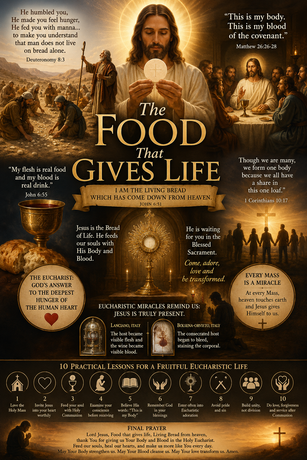
Deuteronomy 8:2-3,14-16, 1 Corinthians 10:16-17, John 6:51-58
Do you know that there is a hunger that ordinary food cannot satisfy. A man can eat with his stomach filled and still feel empty.
A woman can have money and still feel restless. Many people today have mansions and fat accounts they crave yet they are not happy. A family can have everything yet, there is a lack of peace.
Do you know that you can be surrounded by family both nuclear and extended yet, you feel nobody is there for you. You feel almost alone?
This is because there is still a space in your heart that nothing or nobody can occupy. The deepest hunger of the heart is not for the bread, beans, rice, meat or water to drink, the deepest hunger of the human heart is God.
There is a food that gives what no natural food can give. This is the food that wells to eternal life. Despite the need for this food for our salvation, we neglect it and never care how important this food is for our spiritual lives.
That is why Jesus says in the Gospel: “I am the living bread which has come down from heaven. Anyone who eats this bread will live forever.” John 6:51
Today, on the Solemnity of the Body and Blood of Jesus Christ, the Church invites us to look again at the Eucharist and understand this mystery: Jesus is the Food that gives life.
He gives us Himself in the Holy Eucharist. This is not just a food for the stomach or food for Sunday masses. It is the food that the soul craves. It is the food for the wounded, food for the weak, for sinners who want to rise again and for us pilgrims walking through the wilderness of life.
God Feeds His People
From the beginning, God has never abandoned His people in their hunger. In the first reading, Moses tells the Israelites: “Remember how the Lord your God led you for forty years in the wilderness.” Deuteronomy 8:2.
I want you to understand the gist here. During this time, remember that the Israelites were in the desert. They had nothing. There was no money, no where to buy food, no farm to get raw foods to eat. They were tired, very hungry and thirsty as well. Could you think with me, that they are a prefigure of the human race, who are pilgrims walking in the wilderness of life.
We are on a life journey. The people of Israel faced a lot of challenges on the way. Also, we face a lot on our way to eternal life. On their way, God nourished their hunger and fed them. God also has given us the food that will be our strength in the wilderness of life, that is the Eucharist. This is the food given to us by Jesus Christ to give strength and life in our journey to eternity.
God did not leave the Israelites alone. He gave them water from the rock. He guided them through the wilderness. He protected them from danger. And He fed them with manna from heaven.Moses says: “He humbled you, He made you feel hunger, He fed you with manna… to make you understand that man does not live on bread alone.” Deuteronomy 8:3
This is powerful. God allowed them to feel hunger, not because He hated them, but because He wanted to teach them that human beings cannot live by material things alone.
Sometimes, God permits us to pass through our own wilderness so that we may discover what truly gives life. This teaches us that only God can satisfy the soul.
The manna was food from heaven, but it was only a sign. It kept the Israelites alive for a time, but it could not give eternal life. The manna pointed to Someone greater. The manna pointed to Jesus.
From Manna to the Living Bread
In the wilderness, God gave bread from heaven. In the Gospel, Jesus reveals that He Himself is the true Bread from heaven. He says: “I am the living bread which has come down from heaven.” John 6:51 This means Jesus is not only the giver of bread. Jesus is the Bread.
In Luke 22:19–20 when He took bread, gave thanks, broke it, He gave it to them, saying, “This is my body, which is given for you”. While raising the same bread, He calls and affirms the bread as His body.
This is the wonder of the Eucharist. The God who created the universe becomes small enough to be received. The God whom heaven cannot contain allows Himself to be held in the hands of a priest.
The God before whom angels bow comes to us under the appearance of bread and wine. What kind of love is this? From heaven, He came down as a child. From the manger, He went to the Cross. From the Cross, He gave us His sacrifice. From the altar, He gives us His Body and Blood.
The same Jesus who healed the sick, forgave sinners, calmed storms, raised the dead, and died on the Cross is the same Jesus who comes to us in the Holy Eucharist.
Therefore, the Eucharist is not a thing. Quit treating the Eucharist as if it is an ordinary bread. The Eucharist is not a mere reminder. The Eucharist is Jesus. The Eucharist is Holy.
The Mystery of the Eucharist in the Old Testament
Let us have a little walk in the Old Testament.
1.In Genesis 14:18, Melchizedek, king of Salem and priest of God Most High, brought out bread and wine and blessed Abraham. This was not an accident. Melchizedek was both king and priest. He offered bread and wine. He blessed Abraham. Then later when you go through the psalms, you will see where it says “You are a priest forever according to the order of Melchizedek.” Psalm 110:4
This points to Jesus. Jesus is the true King, Priest, the eternal High Priest. Jesus offers not just bread and wine, but His own Body and Blood.Melchizedek gave bread and wine as a blessing.
Jesus gives bread and wine changed into His Body and Blood as source of eternal life, which is the highest and greatest of all blessings.
This means that the Eucharist is a source of divine blessings and eternal life. This is the food that gives life.
2. In Exodus 12, God commanded the Israelites to kill a lamb, put its blood on their doorposts, and eat its flesh.
Through the blood of the lamb, they were saved from death. You remember in the gospel of John when John the Baptist saw Jesus, He said “Behold the Lamb of God, who takes away the sin of the world.” John 1:29.
That means that this also pointed to Jesus. Only Jesus can save us from eternal death and this can only be possible through the Holy Eucharist.
During the Mass, we still hear “Behold the Lamb of God.” Why? Because Jesus is the Lamb sacrificed for us. His Blood saves us. His Body feeds us. His sacrifice gives us life.
That means that the Highest sacrifice on earth is the sacrifice of the Altar. Have you understood why the Holy mass is very powerful?
In the Old Testament, the people ate the Passover lamb. In the New Testament, we receive Jesus, the true Lamb of God. This is the food that gives life.
The Bread that I shall give is my Flesh, for the Life of the World
In today’s Gospel, Jesus says: “The bread that I shall give is my flesh, for the life of the world.” (John 6:51). The people became confused. They asked: “How can this man give us his flesh to eat?” (John 6:52).
This would have been a perfect moment for Jesus to start explaining to them. He would have said “Do not worry, I am only speaking in symbols.” But he did not say that. Instead, He made the teaching even stronger. He says; “If you do not eat the flesh of the Son of Man and drink His blood, you will not have life in you.” (John 6:53).
As if that is not enough, he went on and said “My flesh is real food and my blood is real drink.” (John 6:55) This is the heart of our faith.
Therefore, this sends a strong message to us. That what we eat at the altar is not a symbol or material things representing someone. What we eat at the altar is the body, soul, presence and divinity of Christ.
When He took bread at the Last Supper and said:“This is my body.” (Matthew 26:26). He did not say, “This represents my body.” He did not say, “This is only a sign.” He said, “This is my body.” Therefore, the bread is the body and nothing else.
And when He took the cup, He said: “This is my blood of the covenant.”Matthew 26:28
So, at the altar, our eyes see bread, just as the apostles were seeing bread at this time.
Our tongue still tastes like bread. Just like that of the apostles at this time, it tastes bread.
Yet the reality is deeper and beyond what the ordinary eyes can see. This is the Body and Blood of Jesus Christ, the food that gives life. The Eucharist teaches us that not everything real can be seen.
Grace is real. Love is real. God is real. And Jesus in the Eucharist is real. Yet these things are beyond the ordinary eyes.
Therefore when Jesus says “The bread that I shall give is my flesh, for the life of the world, He is definitely saying that for you to succeed in this life , you need this powerful food. This is the food that gives life.
The Eucharist in The New Testament
In John 6, Jesus teaches clearly that He is the Bread of Life. At the Last Supper, when Jesus gives the Eucharist, He reminds His apostles “Do this in memory of me.” (Luke 22:19). This is the remembrance that continues till today at the sacrifice of the Holy mass.
There are many instances of the Eucharist in the New Testament. On the road to Emmaus, the disciples recognized the risen Jesus “At the breaking of bread.” (Luke 24:35).
In the Acts of the Apostles, the bible informs that the early Christians devoted themselves to the teaching of the apostles, the fellowship, the breaking of bread and the prayers.” Acts 2:42.
St. Paul then tells us: “The blessing-cup that we bless is a communion with the blood of Christ, and the bread that we break is a communion with the body of Christ.” 1 Corinthians 10:16.
So, the Eucharist did not end with the Last Supper. It continued in the life of the Church. It continued in the breaking of bread. It continued in the Holy Mass. It continues today on every Catholic altar. From the early Church to our parish altar today, Jesus continues to feed His people. The food that gives life is still with us.
The Holy Mass: Where Heaven Feeds the Earth
From the above explanations and analogies, you can now come to terms that the Holy Mass is not an ordinary gathering. It is not a place to showcase your dramatic skills.
The holy mass is not a place to read newspapers, it is not an activity to keep chatting and browsing through your phones.
This is sacrilege. The Holy mass is not a place to attend exposing your body.
It is a sacred activity and should be treated the same as sacred. If you read this message today, help me to share it with your friends and families.
The Holy Mass is beyond the beautiful renditions from the choir, It is not just singing.
It is not just preaching. It is not just community prayer.
The Mass is the sacrifice of Christ made present. At Mass, Jesus is the Priest. Jesus is the Lamb. He is the Sacrifice. Jesus is the Food.
Jesus is the Life we receive. This is where graces are received freely.
At every Mass, we are brought spiritually to Calvary. The sacrifice of Jesus is not repeated, because Jesus died once and for all. But that one sacrifice is made present to us.
This is why the Mass is powerful.
In the Holy mass, a weak soul can enter and receive strength.
This is where a guilty soul can enter and receive mercy. The Holy mass is that celebration that a confused soul can enter and receive light.
This is where a wounded soul can enter and receive healing. Where a hungry soul can enter and receive the Bread of Life.
Sometimes we underestimate the Mass because it looks simple. We see a priest, an altar, bread, wine, prayers, and people. But heaven sees more. Heaven sees the Lamb of God.
Heaven sees the altar of sacrifice. Heaven sees angels adoring. Heaven sees Christ giving Himself again to His people. When you go to Mass, do not say, “I am just going to church.”
Say, “I am going to meet the Food that gives life.” This single statement changes everything.
The Holy Communion is not Ordinary Food.
If the Eucharist is truly Jesus, then Holy Communion must never be received carelessly.
St. Paul warns: “Whoever eats the bread or drinks the cup of the Lord unworthily will be guilty of profaning the body and blood of the Lord.” 1 Corinthians 11:27. This is a serious warning.
When you understand that the Holy Communion is not ordinary food. Then we treat the Holy communion as sacred and powerful too. One of the miracles of healing I received as a seminarian is through the Holy Eucharist.
Powerful miracles and healing still occur when you trust the holy communion. So, the Holy Communion is not something we receive because others are receiving. It is not a routine. It is not a public display. It is Jesus entering the soul.
We do not need to be perfect before receiving Communion, because none of us is perfect. But we must be sincere. We must be repentant. We must not knowingly remain in grave sin and still receive the Lord casually.
2.Before receiving Communion, we should ask: Lord, is my heart ready?
Lord, do I need confession? Lord, am I holding hatred against someone? Lord, am I living in a way that offends You? Lord, do I truly believe You are present here?
The Holy Communion is medicine for the weak, hence remember that every medicine must be taken rightly.
When we receive Jesus with faith, He strengthens us. When we receive Him with humility, He lifts us. When we receive Him with repentance, He heals us.
When we receive Him with love, He transforms us. But when we receive Him carelessly, our hearts become cold.
The problem is not that Jesus lacks power. The problem is that sometimes our hearts are closed.
The Eucharist is fire, but a closed heart does not burn. The Eucharist is life, but a proud heart does not receive. The Eucharist is healing, but an unrepentant heart resists the medicine. So today, let us ask for a clean heart.
Conclusion
1. Let us not forget that the Holy Eucharist makes us one body St. Paul says: “Though we are many, we form a single body because we all have a share in this one loaf.” (1 Corinthians 10:17).
This means the Eucharist is not only about “me and Jesus.” It is also about “us in Jesus.” When we receive one Bread, we become one Body.
The point is that we do not actually understand the significance of this. If we are one body in Christ, then there should be no division among us.
So how can you receive the Body of Christ and still hate your brother? How can you receive the Blood of Christ and still refuse to forgive?
Wait! How do you kneel before the altar and rise with bitterness in your hearts? How can we say “Amen” to Jesus and say “No” to love?
Therefore, The Eucharist should make us more merciful, more patient, holy, humble. The Eucharist should make families more united. It should heal the divorce between you and your husband.
The Eucharist should make us more peaceful. What I am saying here is that every Communion is a call to become what we receive.
If we receive the Body of Christ, we must become the hands of Christ to everyone who encounters us. The Eucharist is not only to be adored on the altar. The Eucharist must be lived in daily life.
2. If we also understand the mystery of the Holy Eucharist, then we must also have the hunger to visit Jesus Christ in the Blessed Sacrament often.
Many people today pass near the tabernacle , trespass the adoration chapel, without realizing that the King of kings is there.
Jesus is waiting in silence. He does not shout. He does not force. He does not chase us with noise. He simply waits. The same Jesus who said, “Come to me, all you who labour and are overburdened, and I will give you rest” (Matthew 11:28), is present in the Blessed Sacrament.
Sometimes, the most powerful prayer is silent presence. You look at Him. He looks at you. You bring your wounds, He brings His peace. You bring your weakness, He brings His strength. You bring your emptiness, He brings His life.
The Blessed Sacrament is the hospital of the soul. The tabernacle is the home of the weary. The altar is the table of divine love.
Do not visit Jesus only when you need something. Visit Him because He is worthy of love.
3.The greatest Eucharistic miracle happens at every Mass. Bread and wine become the Body and Blood of Jesus Christ. But sometimes, God gives visible signs to awaken faith.
One famous miracle is the Eucharistic Miracle of Lanciano in Italy. Tradition says that a priest who doubted the real presence of Jesus in the Eucharist saw the host become visible flesh and the wine become visible blood during Mass. This miracle has inspired many people to believe more deeply in the Real Presence.
Another powerful story is the Miracle of Bolsena-Orvieto. Tradition says that a priest struggling with doubt celebrated Mass, and the consecrated host began to bleed, staining the corporal. This miracle became closely connected with the spread of devotion to Corpus Christi.
These miracles remind us still that Jesus is truly present in the Eucharist. But even if we never see blood on the altar, faith tells us what the eyes cannot see.
For those who are miracle seekers, jumping from one place to another, I want you to understand that every Mass is a miracle. Every consecration is a miracle. Many Intentions are answered during this time.
Every Holy Communion is a healing moment. Many receive healing while carrying Jesus christ inside them. The real question is not whether Jesus is present. The real question is whether our hearts are present to Him.
4. In the desert, God fed His people with manna. At the Last Supper, Jesus gave His Body and Blood. On the Cross, He poured out His life. At every Mass, He continues to feed us. This is the mystery of Corpus Christi.
The Eucharist is God’s answer to human hunger. The Eucharist is heaven’s food for earth’s journey.
This food is the strength of the weak, the medicine of the wounded, unity of the Church and the love of Jesus made visible, touchable, and receivable.
So, do not stay hungry when the Bread of Life is available. Do not remain weak when strength is on the altar.
Do not remain far when Jesus is waiting in the adoration chapels and tabernacles.
Do not treat casually the One who gave everything for you. Come to the Mass.
Come to the altar. Come to the Blessed Sacrament.
Come to Holy Communion with a sincere heart. Because Jesus is the Food that gives life. And whoever eats this Bread will live forever.
5. Always attend the mass with faith and reverence. Prepare for the mass in body and soul. The Mass is not ordinary. It is the sacrifice of Christ made present.
Go to Mass with preparation, attention, gratitude, and love. Let us not receive Communion casually.
We have to examine our hearts. Then go to confession when necessary. We have to receive Jesus with faith, humility, repentance, and love.
If you receive Jesus, become more like Jesus. Be more forgiving, merciful, humble, generous, and peaceful. Let the Eucharist change who we are.
Some hunger is emotional. Some hunger is spiritual. Some hunger is hidden. Bring all your hunger to Jesus, the Bread of Life. And remember that Jesus gives Himself to us.
We too must learn to give ourselves in love, service, sacrifice, and kindness to others. Let us also become the food that saves the life of other people and destroys them.
May God give us the grace to hunger for this food that gives eternal life, graces and power to conquer our earthly challenges.. Amen


O SACRAMENT MOST HOLY
O SACRAMENT DIVINE
ALL PRAISE AND ALL THANKSGIVING
BE EVERY MOMENT THINE.
JESUS FOOD OF ETERNAL LIFE
FEED US NOW AND EVER MORE.
AMEN.
Amen
Amen! Thank you Padre. Happy Sunday to you.
A good teaching of what Eucharist really is. Amen Amen
Amen thank you father the word are inspiring
May the Eucharist make us more merciful, more patient, holy and humble. May our families be united through the power of the Eucharist and may all homes and marriages experience love and peace. May all who desires the fruit of the womb receive this miracle through the power of the Holy Eucharist Amen 🙏🏽
Thank you Fr for this powerful and inspirational message, a reminder of the power of the Holy Eucharist.
Amen 🙏
Amen 🙏
Amen
Amen 🙏🙏
Praise you Jesus Christ
thank you Father
hallelujah
AMEN 🙏🙏🙏
May the body and blood of our Lord Jesus Christ bring us to everlasting life. Amen 🙏
AMEN